søndag 9. september 2012

The end of the viking age

During the Viking Age, Scandinavian men and women travelled to many parts of Europe and beyond, in a cultural diaspora that left its traces from Newfoundland to Byzantium. But this period of energetic activity also had a pronounced effect in the Scandinavian homelands, which were subject to a variety of new influences.[44]

 In the 300 years from the late 8th century, when contemporary chroniclers first commented on the appearance of Viking raiders, to the end of the 11th century, Scandinavia underwent profound cultural changes.

In the late 11th century, royal dynasties legitimised by the Church were asserting their power with increasing authority and ambition, and the three kingdoms of Denmark, Norway and Sweden had taken shape. Towns were appearing which functioned as secular and ecclesiastical administrative centres as well as market sites, and monetary economies were beginning to emerge based on English and German models.[45]

By this time the influx of Islamic silver from the East had been absent for more than a century, and the flow of English silver had come to an end in the mid-11th century.[46]

Christianity had taken root in Denmark and Norway with the establishment of dioceses during the 11th century, and the new religion was beginning to organise and assert itself more effectively in Sweden. Foreign churchmen and native elites were energetic in furthering the interests of Christianity, which was now no longer operating simply on a missionary footing, and old ideologies and lifestyles were transforming. It was not until 1103, however, that the first archbishopric was founded in Scandinavia, at Lund (in the southernmost part of present-day Sweden, previously part of Denmark).

The assimilation of the nascent Scandinavian kingdoms into the cultural mainstream of European Christendom altered the aspirations of Scandinavian rulers and those Scandinavians able to travel overseas, and changed their relations with their neighbours. One of the primary sources of profit for the Vikings had been slave-taking. The medieval Church took the position that Christians should not own fellow Christians as slaves, so chattel slavery diminished as a practice throughout northern Europe. This took much of the economic incentive out of raiding, though sporadic slaving activity continued in the 11th century. Eventually, outright slavery was outlawed, and replaced with serfdom at the bottom rung of medieval society. Scandinavian predation in Christian lands around the North Sea and the Irish Sea diminished markedly.


Blar a' Bhuailte, site of the Vikings' last stand in Skye
The kings of Norway continued to assert power in parts of northern Britain and Ireland, and raids continued into the 12th century, but the military ambitions of Scandinavian rulers were now directed toward new paths. In 1107 Sigurd I of Norway sailed for the eastern Mediterranean with a host of Norwegian crusaders to fight for the newly established Kingdom of Jerusalem, and the Danes and Swedes participated energetically in the Baltic Crusades of the 12th and 13th centuries.[47]


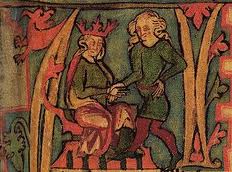
Harald Fairhair or Harald Finehair (Old Norse: Haraldr hárfagri, Norwegian: Harald Hårfagre), (c. 850 – c. 932), son of Halfdan the Black, was the first king (872–930) of Norway. Most of his life remains uncertain, since the most detailed accounts of his life are written around three hundred years after his own lifetime. A few contemporary skaldic poems exist which give only brief information, while the oldest and youngest sagas often disagree on important aspects of his life.[1] Two of his sons, Eric Bloodaxe and Haakon the Good, followed Harald to become kings of Norway after his death.


Viking expansion


The Vikings sailed most of the North Atlantic, reaching south to North Africa and east to Russia, Constantinople and the Middle East, as looters, traders, colonists, and mercenaries. Vikings under Leif Eriksson, heir to Erik the Red, reached North America, and set up a short-lived settlement in present-day L'Anse aux Meadows, Newfoundland and Labrador, Canada.

The motives driving the Viking expansion form a topic of much debate in Nordic history. One common theory posits that Charlemagne "used force and terror to Christianise all pagans", leading to "baptism, converting or death by iron and blood", and as a result "Vikings and other pagans wanted to avenge".[34][35][36][37][38]

Professor Rudolf Simek confirms that "it is not a coincidence if the early Viking activity occurred during the reign of Charlemagne".[39][40] Because of the penetration of Christianity in Scandinavia, serious conflict divided Norway for almost a century.[41]

Another common theory posits that the Norse population had outgrown the agricultural potential of their Scandinavian homeland.[citation needed] For a coastal population with superior naval technologies, it made sense to expand overseas in the face of a youth bulge effect. Raiding by sea may have been easier than trying to carve out new farms in their vast interior boreal forest, which is not highly productive soil. No such rise in population or decline in agricultural production has been definitively proven.

Another explanation is that the Vikings exploited a moment of weakness in the surrounding regions. For instance, the Danish Vikings were aware of the internal divisions within Charlemagne's empire that began in the 830s and resulted in schism.[citation needed] England suffered from internal divisions, and was relatively easy prey given the proximity of many towns to the sea or to navigable rivers. Lack of organised naval opposition throughout Western Europe allowed Viking ships to travel freely, raiding or trading as opportunity permitted.

The decline in the profitability of old trade routes could also have played a role. Trade between western Europe and the rest of Eurasia suffered a severe blow when the Roman Empire fell in the 5th century.[42] The expansion of Islam in the 7th century had also affected trade with western Europe.[43] Trade on the Mediterranean Sea was historically at its lowest level when the Vikings initiated their expansion.[citation needed] By opening new trade routes in Arabic and Frankish lands, the Vikings profited from international trade by expanding beyond their traditional boundaries.[citation needed]


Ancient Vikings - raiders and pirates

The ancient Vikings are a famous people. The history of Vikings is also famous. They came from Sweden, Norway and Denmark. They settled Iceland and other northern islands. One of the Viking people tribes, the Rus, probably gave Russia its name. They discovered America 500 years before Columbus. And they were fearsome raiders raiding and establishing trade colonies from Iceland in the far north, to the Mediterranean Sea in the south, to Russia in the east and to America in the west. So the history of Vikings is very rich.

viking-people
Vikings Disembarking for a Raid. Source: www.kidspast.com.

What is important for our purposes, they played a formative role in the history of Ireland in general and what later became Northern Ireland in particular. And this is why they are featured here. Their influence came in three ways: by raiding, by establishing settlements, and by eventually conquering the island this time known as Normans.

Ancient Viking Raids
Medieval Vikings raids were fearful events and spread terror among the local population. Their history is told in numerous Irish annals as well as Viking sagas. The first recorded raid took place in AD 795 and among the first targets were Innismurray and Innisbofin on the north-west coast of the island. Soon attacks spread throughout the coastal areas of the island. Ulster was attacked in the early AD 800’s and a band of Ulstermen even defeated the fearsome Vikings in an AD 811 engagement. Bangor, in County Down was raided in AD 824. Around AD 832 there was a naval engagement between Vikings and Irish coracle fleet in Lough Neagh and Armagh was subsequently raided.
What made Ireland vulnerable was that at this time there was no strong local authority. The people were divided. The High King who once wielded considerable power from Tara in County Meath, had now lost much of his authority and Ireland was divided into areas controlled by local chieftains often warring against each other. When the raids began, therefore, there was no strong local power to oppose them.

The terror such raids spread is understandable. They would appear in their boats out of nowhere and strike like lightning. With flowing long blond hair and beards, and armed with fearsome axes, and shields, braving cold weather and rough seas, these soldiers were the ultimate fighting forces of the time. England, Scotland, Wales, as well as France and countries further afield also suffered the ravages of their raids.

history-of-vikings

Ancient Vikings Love Monasteries
Favorite targets of Viking raids were monasteries. By AD 795 Ireland was Christian. When local chieftains fought against each other and raided each others’ lands, they generally respected and protected monasteries. Because of this, may rich people would store their wealth and seek refuge among monks in such monasteries; which in turn became known for the wealth hidden in their store rooms. The pagan Vikings had no qualms attacking Christian establishments and realizing that monasteries offered great promise of profit went out of their way to target them. But they also raided rich houses and local communities. The terror they caused is reflected in an ancient prayer that praises “stormy nights when the Vikings do not set out to sea” (Roedahl, The Vikings, p. 222).

The Ancient Vikings Settle Down
In the beginning Viking raids were hit and run events – a lightning attack, followed by a return to the ships and back to Viking lands (which by this time included large portions of Britain). Soon, however, Vikings began to set temporary camps which eventually became more permanent settlements. They used these settlements both as bases from which to raid, but also as trading posts. Limerick was established by Viking raiders in AD 812; Dublin around AD 840; Waterford in AD 914. Apart from these there were major Viking settlements in Wexford and Cork.

ancient-vikings The Ancient Vikings Meet Their Match
From the AD 850’s onwards the Irish began to rally and inflict occasional defeats on the raiding Vikings. Also, as the Vikings settled down they began to fight among themselves just like the Irish had been doing before them. As they settled down they began to intermarry as evidenced from the fact that in the Irish Annals we meet Vikings with Celtic names. Despite these, it would be another 150 years before Ireland was free from strong Viking influence. Those who had settled became integrated into the local society and the raids slowly came to an end. The Vikings themselves were Christianized and turned their attention to more peaceful and noble pursuits.
Back They Come!

SURCE: http://www.my-secret-northern-ireland.com/ancient-vikings.html


The Viking Age and Kaupang by Viksfjord


The Viking Age was a period in European history, especially Northern European and Scandinavian history, spanning the late 8th to 11th centuries.[1][2][3]

Scandinavian (Norse) Vikings explored Europe by its oceans and rivers through trade and warfare. The Vikings also reached Iceland, Greenland, Newfoundland, and Anatolia.[4] Additionally, there is evidence to support the Vinland legend that Vikings reached farther west to the North American continent.

Эпоха викингов 

— принятое в государствах Северной Европы обозначение раннего Средневековья, особенно периода с VIII по XI века, когда местные жители — викинги — совершали набеги на сопредельные государства. Следует за германским железным веком (в Швеции — за Вендельским периодом).


Kaupang was a Norse term for market-place. Today, it is generally used as a name of the first town-like market-place in Norway, the Kaupang in Skiringssal, which is located in Tjølling near Larvik in Vestfold. Kaupang was an important merchant and craft center during the Viking period and as yet the first known Norwegian trading outpost.

Kaupang was founded in the 780s and abandoned for unknown reasons in the early 10th century. It was situated on a beach by Viksfjord in Larvik municipality. Documentary sources indicate that the area was an important royal seat in the 700s and 800s.

Archaeological evidence indicates that the site might have been the first proto-urban settlement of some significance in Norway. The excavations which have been conducted at Kaupang have found evidence for a handicraft and commercial center, with around 1,000 inhabitants. The city had diverse craft production and extensive trade with foreign countries. Commodities traded included iron, soapstone and perhaps fish.


The Vikings (from Old Norse víkingr) were the Norse explorers, warriors, merchants, and pirates who raided, traded, explored and settled in wide areas of Europe, Asia and the North Atlantic islands from the late 8th to the mid-11th century.[1]

These Norsemen used their famed longships to travel as far east as Constantinople and the Volga River in Russia, and as far west as Iceland, Greenland, and Newfoundland, and as far south as Al-Andalus.[2] This period of Viking expansion – known as the Viking Age – forms a major part of the medieval history of Scandinavia, Great Britain, Ireland and the rest of Europe.

Popular conceptions of the Vikings often differ from the complex picture that emerges from archaeology and written sources. A romanticised picture of Vikings as Germanic noble savages began to take root in the 18th century, and this developed and became widely propagated during the 19th-century Viking revival.[3]


The received views of the Vikings as violent brutes or intrepid adventurers owe much to the modern Viking myth which had taken shape by the early 20th century. Current popular representations are typically highly clichéd, presenting the Vikings as familiar caricatures.[3]


The Consept: Wikingland Tema Tour

Our vision/Vår visjon:
Tilby opplevelsesreiser fra St. Peterburg rettet mot betalingsvillige kunder som ønsker kvalitet og individualitet i sin ferieopplevelse og da særlig mot kunnskapsgivende aktiviteter.

Produktet er tematurer: 
"I vikingenes fotspor - opplev det beste av sør-Norge"

- En historisk reise fra vikingtiden til dagens moderne Norge der det legges vekt på utvalgte kvalitative opplevelseselementer.


"Prekestolen" i Rogaland. Actress Marlene Kjellså, the directors dougther...

 Lysefjord, Rogaland

Replika of "Oseberg", buildt by traditional viking craft methods and tools i Tønsberg harbour.

The replica project

 Stiftelsen Nytt Osebergskip i Tønsberg er en ideell stiftelse registrert i 2005 for å bygge en arkeologisk replika av Osebergskipet i samarbeid med Kulturhistorisk Museum/Vikingskipshuset, Vikingeskibsmuseet i Roskilde, NTNU/Marintek samt fagmiljøet innen tradisjonsbåtbygging.
Byggingen startet i juni 2010. For første gang siden vikingtiden bygges et vikingskip kun ved bruk av datidens arbeidsmetoder og verktøy. Skipet skal være tilgjengelig for allmennheten i sommermånedene med base sentralt i Tønsberg havn. Om vinteren vil det utgjøre kjernen i en permanent utstilling om Osebergfunnet i en innebygget tørrdokk som Tønsberg havnevesen har vedtatt å bygge utenfor hotellet. Slik blir dette prosjektet til enhver tid synlig.


  Bildet er tatt sommeren 2010 (foto: Sverre Chr. Jarild)

"Modern Times" - Norwegian Oil&Gas Adventure

FAKTA
Olje-eventyret
  • Den 25. februar 1958 skrev Norges geologiske undersøkelse til Utenriksdepartementet i forbindelse med forhandlingene om havets folkerett i Geneve: "man kan se bort fra muligheten for at det skulle finnes kull, olje eller svovel på kontinentalsokkelen langs den norske kyst".
  • Den første boring etter olje på norsk kontinentalsokkel startet i et område 160 km sørvest for Stavanger 19. juli 1966, men boreriggen "Ocean Traveler" boret tørt.
  • 9. juni i 1967 avsluttet "Ocean Traveler" en ny brønn det det ble funnet de første spor av olje på lisens 001 for Esso. Funnet var den gang ikke økonomisk lønnsomt, men ledet til Balderfeltet som ble oppdaget i 1974.
  • Ett år senere, 24. juni 1968, ble gassfeltet Cod ved Ekofisk funnet, men heller ikke her var det den gang lønnsomt å ta opp oljen. I dag er Cod en del av feltene i Ekofisk-området.
  • Høsten 1969 fikk oljeselskapet Phillips full treff 3081 meter under havbunnen på Ekofisk. Etter en problematisk boring og produksjonstesting, ble brønnen sikret 1. juledag. En ny brønn bores ferdig i april 1970 og 2. juni 1970 bekrefter Phillips at de har gjort et gigantfunn av olje.
  • Statsminister Trygve Bratteli foretok den offisielle åpning av prøveproduksjon fra boreriggen "Gulftide" 9. juni 1971 på Ekofisk-feltet. Norge var på vei til å bli en oljenasjon.
  • I perioden 1971 til 1998 er bruttoverdien av olje- og gassproduksjonen fra alle feltene som Phillips opererer på Ekofisk, på 935 milliarder kroner (i 1998-kroner).
  •  

    Endelig skjedde det noe stort i Nordsjøen!

    flamme Den 21. august 1969 startet Phillips boring på blokk 2/4 med Ocean Viking. Boret trengte snart inn i en gasslomme. Olje og gass strømmet opp sammen med boreslammet. På grunn av risikoen for en ukontrollert utblåsing ble brønnen støpt igjen med sement fra topp til bunn. Etter flytting en kilometer, trengte den 25/10 boret inn i et oljereservoar. Stormer vanskeligjorde imidlertid testing. I november måtte riggen rømme stedet og deler av mannskapet evakueres. Men den 7/12 fortsatte testingen. Da brønnen ble forlatt lille julaften i 1969, visste mange at det var gjort et gigantisk oljefunn.

     Troll and Eifel ... in real scale.


    Norsk oljehistorie på 5 minutter

    Ved utgangen av 1950-årene var det få som trodde på olje- og gassrikdommer langs norskekysten. Hendelsen som åpnet folks øyne for at det kunne være hydrokarboner i Nordsjøen var det nederlandske funnet av gass i Groningen i 1959. Dette funnet førte til entusiasme i en del av verden der energikonsumet i stor grad baserte seg på kull og importert olje. I iveren etter å finne mer ble oppmerksomheten rettet mot Nordsjøen. Norges geologiske ekspertise var negativ til olje- og gassforekomster, men dette kunne ikke stoppe entusiasmen etter gassfunnet i Nederland.

    I oktober 1962 sendte Phillips Petroleum et brev til myndighetene i Norge om tillatelse til leting i Nordsjøen. Selskapet ville ha lisens for de delene av Nordsjøen som lå på norsk territorium og som muligens ville komme innunder norsk sokkel. Tilbudet var på 160.000 dollar per måned. Tilbudet ble sett på som et forsøk på å få eksklusive rettigheter. Det var utelukket for myndighetene å overlate hele sokkelen til et selskap. Dersom områdene skulle åpnes for leting måtte flere selskaper inn.

    I mai 1963 proklamerte regjeringen Gerhardsen Norges suverenitet over den norske kontinentalsokkelen. Ny lov slo fast at staten var grunneier og at bare Kongen (regjeringen) kunne gi tillatelser til leting og utvinning. Selskapene fikk muligheten til å foreta forberedende undersøkelser det samme året. Tillatelsene ga blant annet rett til seismiske undersøkelser, men ikke til boring.

    Selv om Norge hadde proklamert statshøyhet over store havområder gjensto det noen viktige avklaringer angående deling av kontinentalsokkelen, primært med Danmark og Storbritannia. Avtaler om deling av kontinentalsokkelen etter midtlinjeprinsippet ble inngått i mars 1965. Første konsesjonsrunde ble utlyst 13. april 1965. Det ble tildelt 22 utvinningstillatelser for 78 blokker til oljeselskaper eller grupper av selskaper. Utvinningstillatelsene ga enerett til å undersøke, bore og utvinne i konsesjonsområdet. Den første letebrønnen ble boret sommeren 1966, den var tørr.
     Ekofisk
    Ekofisk - Flyfoto
    Med funnet av Ekofisk i 1969 startet det norske oljeeventyret for alvor. Produksjonen fra feltet tok til 15. juni 1971. I årene etter ble det gjort en rekke store funn. I 1970-årene var letevirksomheten konsentrert til områdene sør for Stad. Sokkelen ble gradvis åpnet og kun et begrenset antall blokker ble utlyst i hver konsesjonsrunde. I startfasen dominerte utenlandske selskaper letevirksomheten og de sto for utbyggingen av de første olje- og gassfeltene. Statoil ble opprettet i 1972 og regelen om 50 prosent statsdeltakelse i hver utvinningstillatelse ble etablert. Denne regelen ble senere endret til at Stortinget kan vurdere om andelen kan settes lavere eller høyere i hvert enkelt tilfelle.
    Fra 1. januar 1985 ble petroleumsvirksomheten omorganisert. Deltakerandelen til staten ble delt i to, en knyttet til selskapet og en knyttet til statens direkte økonomiske engasjement i petroleumsvirksomheten (SDØE). SDØE er en ordning der staten eier en andel i en rekke olje- og gassfelt, rørledninger og landanlegg. Andelen blir fastsatt ved tildeling av utvinningstillatelser og størrelsen varierer fra felt til felt. Som en av flere eiere dekker staten sin del av investeringer og kostnader, og får en tilsvarende del av inntektene fra utvinningstillatelsen. Våren 2001 vedtok Stortinget at 21,5 prosent av verdien av SDØE andelene kunne selges. 15 prosent ble solgt til Statoil og 6,5 % ble solgt til andre rettighetshavere. Salget av SDØE andeler til Statoil ble sett på som et viktig element i å gjennomføre en suksessfull børsnotering og privatisering av Statoil. Statoil ble børsnotert i juni samme år og opererer nå på lik linje med enhver annen aktør på norsk kontinentalsokkel. Statsaksjeselskapet Petoro ble opprettet i mai 2001 for å ivareta SDØE på vegne av staten.
    Petroleumsvirksomheten har hatt mye å si for den økonomiske veksten i Norge, og for finansieringen av det norske velferdssamfunnet. Gjennom over 40 års virksomhet har næringen skapt verdier for godt over 8000 milliarder kroner, målt i dagens pengeverdi. I 2009 sto petroleumssektoren for 21 prosent av verdiskapingen i landet. Verdiskapingen er tre ganger høyere enn i landindustrien, og rundt 22 ganger den samlede verdiskapingen i primærnæringene.
    Oljeplattformen Kristin
    Siden oppstart av petroleumsvirksomheten på norsk kontinentalsokkel er det investert enorme summer i leting, utbygging av felt, transportinfrastruktur og landanlegg. Per 31.12.2009 var det investert omkring 3000 milliarder kroner, målt i dagens pengeverdi. Videre ble det i 2009 investert godt og vel 134 milliarder kroner. Dette utgjør 26 prosent av de samlede realinvesteringene i landet.
    Oljeplattformen Kristin, foto: Statoil. 
    Om lag 40 prosent av den tilstedeværende, utvinnbare oljen og gassen på norsk kontinentalsokkel er produsert og solgt siden starten i 1971. Produksjonen av olje (inkl NGL) nådde en topp i 2001 på 3,4 millioner fat per dag. Ved utgangen av 2009 var 65 felt i produksjon på norsk kontinentalsokkel. Oljeproduksjonen var i 2009 på 2,4 millioner fat per dag og forventes gradvis å avta i årene som kommer. Gassalget derimot vokser. Gassalget i 2009 var på 103,5 milliarder Sm3. Fra å utgjøre rundt 43 prosent av den norske petroleumsproduksjonen i 2009 vil gassproduksjonen trolig øke til over 50 prosent i 2013.

    (Oppdatert 11.2010)
    Kilde: http://www.regjeringen.no/nb/dep/oed/tema/olje_og_gass/norsk-oljehistorie-pa-5-minutter.html?id=440538


    "Toll" (Shell) på vei ut til feltet.  

    Fakta om utviklingen av Trollplattformen
    Plattformen måler 472 meter fra toppen av flammetårnet til bunnskjørtet, og er den høyeste betongstrukturen noensinne flyttet på jordens overflate. Den totale vekten er 1,050,000 tonn. Under taueoperasjonen hadde plattformen 140 meter fribord fra bunnen av dekket til vannoverflaten. Ruten for tauingen var 174 nautiske mil, og denne operasjonen tok rundt seks dager. Plattformen er posisjonert på 303 meters havdyp.


    "Draugen" - Oljeproduksjon startet på 
    Haltenbanken 9 august 1993.


     Panoramio - Photo of Oljemuseet i Stavanger


    The project: "WikingLandTour"


    Established 24. august 2012
     
    A JointVenture Kulturprogram, 
    managed by Pjotr Novik and Harald Kvinnsland Dollst,
    in the firm named AO Wikinglandtour Ltd.
     
    Norwegian firm: 
    AO Wikinglandtour Ltd (NUF)
    No 9xx xxx xxx VAT
     
    Office and management by Kvinnsland Audit AS
    Address: Blokksberg, Skrenten 29 B, N-3258 Larvik, Norway
     
     Office: Stavanger - Larvik - St.Petersburg
    Mail: post@wikinglandtour.com
    Phone: (+47) 90679008 (Norway)
    Phone: (+7) 812..... (Russia) 
    Fax: (+47) 331 87 102

    Comming soon: 
    wikinglandtour.no - wikingland.ru - wikinglandtour.com
    (Where you will be able to visit our internett business pages.)
     

    The management,  Pjotr Novik and Harald Kvinnsland Dollst

     Handmade by Stiftelsen Nytt Osebergskip craftsmenn.